


Under the wave of automotive intelligence, power management is emerging as a new cornerstone of semiconductor value growth.
As electrification and intelligent transformation accelerate across the automotive industry, the global automotive semiconductor market is projected to expand from approximately USD 67.7 billion in 2024 to nearly USD 96.9 billion by 2029, achieving a CAGR of 7.4% from 2024 to 2029.
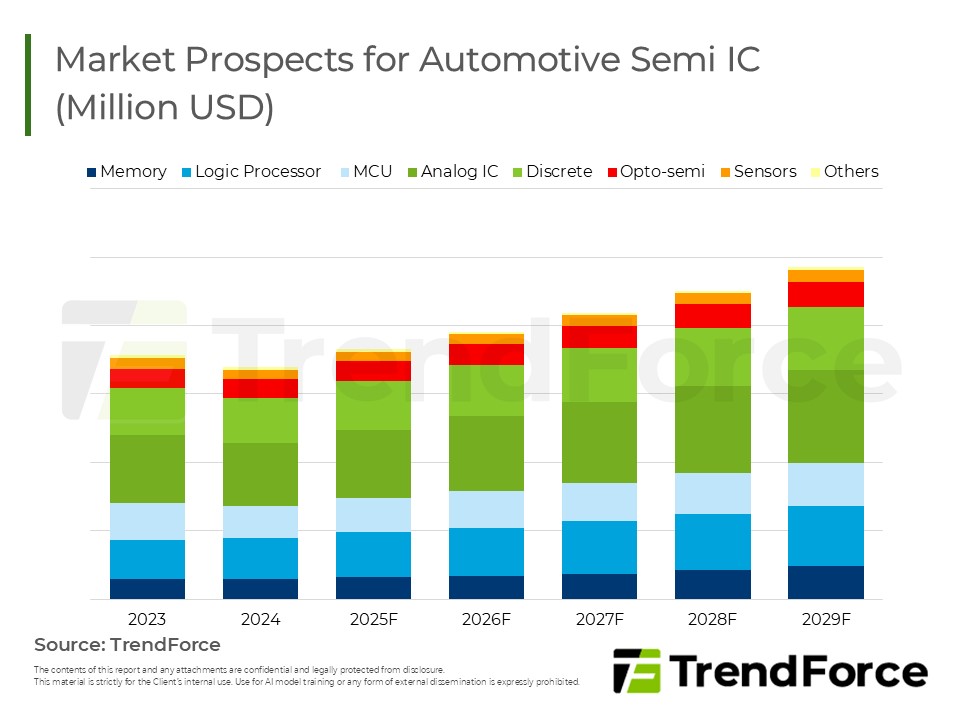
However, this growth is far from evenly distributed. High-computing chips—such as logic processors and high-performance memory—are growing significantly faster than traditional components like microcontrollers, reflecting a rapid shift in market value toward core technologies that enable electrification and intelligent functions.
By 2025, the global penetration rate of electric vehicles (including BEV, PHEV, FCV, and HEV) in new vehicle sales is expected to rise to 29.5%. At the same time, the automotive industry is accelerating its intelligent transformation, relying heavily on multi-sensor configurations, high-speed communications, and AI model deployment. The evolution of electronic and electrical (E/E) architectures—from distributed systems to domain-centralized and centralized architectures—has become a critical trend. Massive data volumes from multi-sensor systems, along with the rapidly increasing parameter size of AI models, are driving exponential growth in computing demand for in-vehicle processors.
In parallel, automakers are integrating functions across body control, remote processing, intelligent driving, and smart cockpit domains to varying degrees, with chipmakers playing a pivotal role in this process. As semiconductor vendors introduce cockpit/ADAS integrated SoCs, 2025 marks the first year of large-scale commercialization for these solutions. Controller integration helps reduce the number of control units, enables component sharing, simplifies wiring harnesses, and delivers significant cost benefits—further accelerating the adoption of automotive intelligence. According to TrendForce, the CAGR of automotive logic processors from 2024 to 2029 will reach 8.6%, exceeding the industry average of 7.4%.
Behind these trends lies a fundamental shift in automotive competition.
The industry is moving from a focus on mechanical performance to competition based on digital intelligence, where intelligent driving and cockpit experiences depend directly on chip computing power.
The centralization of E/E architectures and the deployment of cockpit-ADAS integrated SoCs are not only reshaping hardware systems, but also imposing unprecedented demands on power supply systems—higher power density, faster dynamic response, and more refined energy management.
As a result, power management technologies are evolving from a supporting role into a critical bottleneck that directly impacts vehicle performance and safety.
As the power consumption of individual chips climbs toward hundreds of watts, traditional 12V electrical architectures are reaching their limits, making the transition to 48V and higher-voltage platforms inevitable. Correspondingly, demand is surging for high-efficiency power semiconductors (such as SiC and GaN), advanced power topologies, and intelligent power distribution systems. The ability to deliver stable, efficient, and intelligent energy to the vehicle’s “digital brain” has become a central challenge the industry must confront.
The World Power Industry Expo 2026 brings together leaders in semiconductor design, power electronics, and power architecture to showcase and explore cutting-edge solutions in high-voltage platform migration, multi-domain power distribution management, chip-level power delivery, and thermal management. By mapping the technology landscape and fostering cross-disciplinary dialogue, the expo is dedicated to building “computing–energy co-optimization” standards that support the next generation of intelligent vehicles.
The World Power Industry Expo addresses a core question shaping the future:
How can intelligent computing power continue to scale within finite physical and energy boundaries?
The answer points toward a high-level global platform that unites worldwide innovation to achieve deep integration between energy and information.
Source: https://www.trendforce.com/research/download/RP251201XH